
What do you need to teach English in Asia? Do you need a teaching license, experience or TEFL certification? The basic requirements to teach English abroad in Asia (specifically Eastern Asia) are usually to be a native English speaker and to hold a four year university degree in any discipline. But each school and country is a little different.
South Korea, China, Japan, and Taiwan each have different requirements for foreign English teachers. A bachelor's degree and being a native speaker is typically the most basic requirement, while a teaching license, TEFL/TESOL certification, experience, and other credentials may be required or preferred depending on the position.
This guide goes into details on what you will need in all four of these countries.
What are the requirements to teach English in East Asia?
First we'll look at the general requirements to teach English in the following countries. I spent 8 years living in these four countries.
| Country | Degree Required? | Native English speaker? | TEFL/TESOL required? | Criminal Record Check? | Apostille / authentication? | Typical Visa Type |
|---|---|---|---|---|---|---|
| South Korea | Yes (4-Year Degree except for the TALK program) | Yes, native speaker | Depends on employer and your qualifications | Yes | Yes (Degree & Background Check) | E-2 Visa |
| China | Yes (4-Year Degree) | Native speaker or non-native European in smaller tier cities | Usually | Yes | Yes (Degree & TEFL Certificate if required) | Z Visa |
| Taiwan | Bachelor's or possibly associate's + TEFL | Yes, native speaker or WHV | Not usually | Yes, since 2017 | Varies by native country | ARC via Buxiban |
| Japan | Yes (4-Year Degree) | Yes, native and non-native speaker | Not usually | Typically no | No (Copy of diploma suffices) | Instructor / Specialist |
The requirements to teach English in Korea
South Korea has some of the most intensive requirements for foreign teachers. Obtaining the necessary documents can take 3-5 months. For an E-2 visa (legal teaching visa):
- You need to be a native English speaker from the USA, England, Scotland, Wales, Ireland, South Africa, Australia, New Zealand or Canada.
- You need to have a bachelor's degree in any discipline.
- Clean health check.
- Clear criminal background check. Learn more.
- Apostilled diploma. More.
- Drug testing done when you arrive.
At one time if you had a 2 year degree completed or an associate's degree then you could teach English in the TALK program in Korea, however this was discontinued in '21.
Student, spouse, or heritage visas may also enable you to legally teach English in Korea.
TEFL certification?
TEFL certification is not required to process your E-2 visa, however individual schools and programs can set their own requirements. Hagwons do not typically require TEFL certification although an individual hagwon may prefer it. Public school programs like EPIK often do.
According to EPIK you may need a TEFL certification of at least a 100 hours to teach in a public school in Korea if you don't have a teaching license or education focused degree. Online courses can work, however in Busan, EPIK has stated a preference for courses with 20 in-class hours.
Learn more:
- Korean governments qualifications for native speaking instructors (E-2)
- What's it like to teach English in Korea?
- Salaries to teach English in Korea
- Requirements to teach English in Korea (an A-Z guide)
The requirements to teach English in China
The qualifications to teach English in China have gotten more intensive over the years. China is a large countr with a decentralized system and some of its rules can fluctuate from city to city, province to province and school to school.
For a Z visa (foreign expert certificate):
- You need to be a native English speaker from the USA, England, Scotland, Wales, Ireland, South Africa, Australia, New Zealand or Canada.
- You need to have a bachelor's degree in any discipline and a copy of it notarized and apostilled.
- You often need TEFL certification notarized.
- Criminal background check.
- Clean health check done after arriving in China.
- Have 2 years post grad work experience.
Exceptions...
There can be exceptions to the requirements which tend to vary from city to city. For example, I have met non-native English speaking Europeans who got Z visas to teach English in public schools in China.
Tier 1 cities like Shanghai and Beijing tend to have the most strict requirements. Tier 2 and smaller cities tend to be more flexible and may allow non-native English teachers positions. They may occasionally process alternative work permits if the applicant has near-native fluency, a clean criminal record, a degree, and a desperate school sponsor.
Here's a comment about the age limit and "rules" in China.
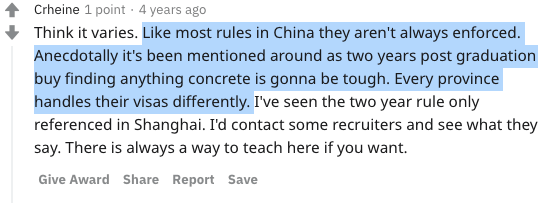
Shanghai is a tier 1 city and the 2 year post grad experience rule refers to any work experience not necessarily related teaching experience.
What the Chinese government says...
Here is a quote from a Chinese government site in regards to visas for teachers.
"Teachers of foreign languages. Teachers of foreign languages generally shall be engaged in the teaching of their native languages and shall have a bachelor’s degree or higher degree and language teaching experience of at least two years.
Those who have had degrees in the field of education, language or teaching, or have acquired a qualification certificate of teaching at their own countries or a recognized international certificate of language teaching shall be exempted from the restriction on work experience."
Evaluation Criteria for Foreigners Employed in China
In my experience I met quite a few people teaching English in China without a degree, but this was 10+ years ago and I cannot confirm what kind of visa they had or if it was illegal or not.
One thing to keep in mind when teaching in China is that there can sometimes be a difference between what schools or recruiters tell you and what the official regulations actually require. Enforcement and implementation can also vary by location as mentioned above. Just because you hear about someone working under certain circumstances doesn't necessarily mean that arrangement is legal or that you will qualify for the same arrangement.
Learn more:
- China's goverment site on criteria for employed foreigners
- The requirements to teach English in China
- What's it like to teach English in China?
- Salaries to teach English in China
The requirements to teach English in Japan
The requirements and qualifications you need to teach in Japan and Taiwan tend to be less intensive than Korea or China.
- You usually need to be a native English speaker from the USA, England, Scotland, Wales, Ireland, South Africa, Australia, New Zealand or Canada.
- You need to have a bachelor's degree in any discipline. A copy of your diploma will usually suffice. Apostilles are not usually required.
Can you teach English in Japan if you aren't a native speaker? Yes, you can, however most schools will prefer native speakers, however if you can demonstrate high level or near native speaking skills you may qualify for a position.
I met a German girl teaching here in Fukuoka and the school never actually asked her for proof. But most Germans speak English well.
I also met someone taking the course who was teaching in Japan legally and he wasn't a native speaker.
According to the Ministry of Justice in Japan:
Any of the following documents certifying educational background or work history, etc.
a. A certificate of graduation from a university, a document certifying that you have received an education equivalent to or higher than this, or a document certifying that you have been granted the title of diploma or advanced diploma.
b. One copy of a document certifying that you have a driver's license, etc.
c. A person who intends to educate a foreign language should have one document certifying that he/she has been educated in the foreign language for 12 years or more.
- Source
These are the basic qualifications to get a visa teaching English in Japan. If you don't have these there are other visas such as spouse or working holiday visas (18-30 years old) if you are from one of the common wealth countries.
Different schools can have there own individual requirements or preferences for teachers that may be beyond what the immigration requirements are. And finally here is some information about elgibility for teaching in the JET program in Japan.
Learn more:
- Japan's application for certificate of elgibility
- What's it like to teach English in Japan?
- Salaries to teach English in Japan
- Can I teach English in Japan without speaking Japanese?
The requirements to teach English in Taiwan
- Typically you need to be a native English speaker from the USA, England, Scotland, Wales, Ireland, South Africa, Australia, New Zealand or Canada.
- You usually need to have a bachelor's degree in any discipline (or in some cases an associate's and TEFL certificate).
- A criminal background check is now mandatory for new teachers since 2017.
- A teaching license (required in public schools).
The first three qualifications are required to teach English in a buxiban. Additionally you'll need a 'teaching license' to teach English in a public school.
According to law.moj.gov.tw:
1. Be 20 (twenty) years old or above.
2. Be graduated from colleges or above.
3. The language to be taught by the foreign teacher is the official language used in the country specified in the passport of the teacher.
The foreigners mentioned in the preceding paragraph shall have qualification certificates for language teaching if they have not obtained bachelor‘s degrees.
- Source (see chapter 4)
This suggests that if you have not yet obtained a bachelor's, you are at least 20 years old, and you have a language teaching certificate then you may be elgible for employment in a buxiban in Taiwan.
Additionally this page states:
Foreigners shall meet the following qualifications:
1.Be 20 (twenty) years old or above.
2.Be graduated from colleges or above. If foreigners have not obtained bachelor‘s degrees, they shall have qualification certificates for language teaching.
3.The language to be taught by the foreign teacher is the official language used in the country specified in the passport of the teacher.
Upon further research the word college in Taiwan often refers to an educational program between high school and a bachelor's degree.
And HESS education which is one of the largest buxibans in Taiwan with multiple chains across the island states that they will accept an associates and TEFL certificate or a bachelor's degree.
Working holiday visa
If you are between the ages of 18-35 and from a common wealth country you may qualify for a working holiday visa which may enable you teach English.
Can non-native English speakers teach English in Taiwan?
Yes, like other countries in East Asia a spousal visa or residence visa may permit it. Non-native English speakers may also be able to find positions if they can demonstrate near native speaking abilities.
Learn more:
- Taiwan's ministry of education
- How to get a job teaching English in Taiwan
- What's it like to teach English in Taiwan?
- Salaries to teach English in Taiwan
Other qualifications and preferences to teach in Asia
Is being a native English speaker and having a degree the only qualifications that you need? Not in all cases. Those are the basic requirements to get a legal working visa teaching in a public school, private school or university. Sometimes schools can require or prefer additional qualifications. Different schools can have different requirements. Some of the other preferences or requirements that you may find when you start looking for a job are the following.
- Experience
- Related degrees in English
- Teaching licenses
- Master's degrees
- TEFL/TESOL/CELTA certificates
1. Experience
Research shows that most schools will prefer teachers with experience. The more experience you have the more options you'll have. Some schools will prefer that you have experience teaching in their country or they may want you to have experience teaching a certain age group.
Why would they prefer a teacher with experience?
There are a few different reasons. First is they want a teacher who can adapt because some new teachers can't adapt to living in a foreign country. They can have issues with the culture or just be unhappy which can rub off on the school and it's students.
Then there is the teaching. Teaching can be quite challenging especially teaching children and teens. Experienced teachers tend to be better teachers. Better teachers tend to be liked more by their students and they can handle difficult students better. Parents can also be involved because in the case of private acadamies (hagwons, buxibans, training centers and eikaiwa) they are paying customers.
Despite most schools prefering teachers with experience there are jobs and schools that are willing to hire first time teachers.
How can I teach English abroad without any experience?
2. Related degrees in English
Any degree is usually fine however, some schools may prefer to see a related degree. Degrees in English, English literature or other related degrees can be looked upon favorably.
3. Teaching licenses
These are not usually required. However, they are in a few places. To teach English in a public school in Taiwan you will need to have a teaching license from your home country. In Korea, Japan and China you don't necessarily need that to teach in a public school. Also to teach in most international schools you will usually need this qualification as well.
4. Master's degrees
Although they are not common a few schools may also require you to have a master's degree, these are often universities in Japan and Taiwan. Universities in Korea or China do not usually require them although they may.
5. TEFL/TESOL/CELTA certificates
Aside from experience some employers may also prefer that you have a TESOL, TEFL, CELTA or other language teaching certificate.
- TESOL=Teaching English to Speakers of other languages
- TEFL=Teaching English as a Foreign Language
- CELTA=Certificate in Teaching English to Speakers of Other Languages (until 2011 it stood for Certificate in Teaching English to Adults)
In many cases these kinds of courses can be interchangeable with one another as far as finding a job goes.
These are typically short term courses that can be taken in-class or online. They can last anywhere from a couple of days to a couple of months. You can teach English without a TEFL certificate in many places and these are not usually legally required to get a visa to teach English in Asia and they do not replace requirements for degrees.
That being said these can be preferred by some schools. They can be a good way to improve your resume if you have no experience. More importantly the point of these courses should be to train and prepare you to do your job NOT just get a job. A good course will help prepare you and a poor one won't. A course targeted at the age group you will teach is best. However, most courses are one size supposedly fits all. You can teach adults or children, but the majority of jobs teaching in Asia are for teaching children so if I was you I would take a course targeted at teaching children unless you are sure you want to teach adults.
TEFL course hours are a label and often a misnomer. They do not say anything about the quality of a course. They are typically not based on actual time in a course. Online they are asynchronous courses where you can work on them as you like within a certain timeframe such as a month. They can range from 20 hours to 200 hours.
In-class courses like CELTA stood for "Certificate in English Language Teaching to Adults". In 2011 they apparently stated the course stood for "Certificate in Teaching English to Speakers of Other Languages". These courses were 120 hours in a classroom which was 4 weeks for 30 hours each week. Many other TEFL courses modeled CELTA. Some might call these courses "look alikes" or copycats. Online TEFL courses did the same and some of these so-called "120 hour" courses can be completed within a couple of days.
The truth is many positions requiring a so-called 100 or 120 hour course such as EPIK in Korea may accept any "120 hour" course, cheap or expensive online or in-class. Those may be sufficient for checking a box and getting you hired, but getting a job is just the beginning and the real work comes when you step into that classroom. I would not expect much if any training by the school. Perhaps you might shadow another teacher for a couple of days, but you will be generally on your own.
Will a 168 hour course beat an applicant with a 120 hour course? Again the number of course hours is just a label I would not count on it as there are many different qualifications and preferences that employers consider.
I would expect to be thrown into a classroom (likely full of children) and told to teach. Teaching children can be very difficult and most TEFL courses are general one size supposedly fits all courses which are usually tailored more towards teaching adults than children. In my experience can be very heavy on teaching theory, grammar study and lack practical applications which you will need when you step into that classroom.
Read more on whether a TEFL course is worth it or not.
How confident are you in your abilities to teach English to children?
TEKA is a visually rich and practical multi-media course designed to help you teach English to children.
"I've spent many years teaching ESL without certification, but to be considered for lots of jobs I needed to get one. This course saved me thousands of dollars and reminded and taught me lots of new activities and games that work. I find that sometimes even tired adults like the kind of fun, physical games I learned here...
...Right after I took this course I was offered a job in Saudi Arabia that had stipulated they needed an in-person TEFL in their ad, but when I looked at their paper work after the interview, it looks like they counted this certificate as valid, and I was offered a job. I was really glad I had stumbled upon Ian's site. Thanks, Ian" - Emily's review on ESLinsider's course
FAQ
Can you teach English in East Asia without a bachelor's degree? In most cases you need a four year degree to attain the proper visa which enables you to teach, however there are different visas such as spousal visas, heritage visas and working holiday visas (WHV) that may enable you to legally teach English. In some places an associate's and TEFL certification may work. Read more about teaching English without a degree.
Can non-native English speakers teach English in East Asia? Yes, this is more possible in some places like Japan, Taiwan and China. However, that depends on location, your qualifications and if you can demonstrate a near native speaking ability. Native speaking teachers with the proper qualifications such as a degree will normally be preferred.
Do you need a TEFL certificate to teach English in East Asia? TEFL certification is typically not a qualification that is needed to attain your proper work visa in South Korea, Japan or Taiwan. However, as stated above certain schools or programs can set their own preferences. China is often more strict and in China if you don't have 2 years of teaching experience or a teaching license then you may need a language teaching qualification. Programs like EPIK in Korea have a similar requirement.
Can you teach English in East Asia without teaching experience? Yes, you can as teachers come and go, however most schools prefer teachers with experience. Read more about what employers want.
Which East Asian country has the easiest requirements for English teachers? Currently I would say Japan. The most intensive would be South Korea and China.
Can you teach English in Asia if you're over 50? Yes. In Taiwan there is no strict international age limit although retirement age for the public sector is 65 years old. In Japan the benchmark for retirement is 60 years old. In China the age limit for a Z visa is 60 years for men and 55 for woman. Private language schools and kindergartens may prefer younger teachers aged 25-40 as they are high energy environments. In Korea the retirement age is 62 years. Read more on the age limit.
Which country is best to teach in? The best location for teaching abroad entirely depends on you.
Do you need to be bilingual to teach English abroad? No, you do not. Read more about that.
What kind of salary do English teachers make in East Asia? Salaries range from roughly $1500-2500 USD a month in South Korea, Taiwan and Japan. In China salaries range from about $1000-2500. Your salary and benefits will depend upon your employer, school type, location and qualifications. Check out this post for full details on salaries and wages for English teachers in China, Taiwan, Japan and South Korea.